

You have three browser tabs open, each showing a beach, a certificate and a price. They look alike until you ask what you will study, who will teach you, what the whole trip costs, and what happens after the final assessment. Those four answers are where schools differ.
What is the short answer to choosing yoga teacher training abroad?
Choose the program you can afford, attend fully, and explain clearly to a friend. Get the curriculum, lead trainers, certificate, schedule, total travel cost, accommodation, entry requirements and follow-up support in writing from each school. Then pick the one whose answers fit your goals, whatever the destination looks like.
What should I ask before booking yoga teacher training abroad?
Ask the 18 questions below, grouped into eight topics. A good answer lets you picture a training week, add up the full budget, and see your next step.
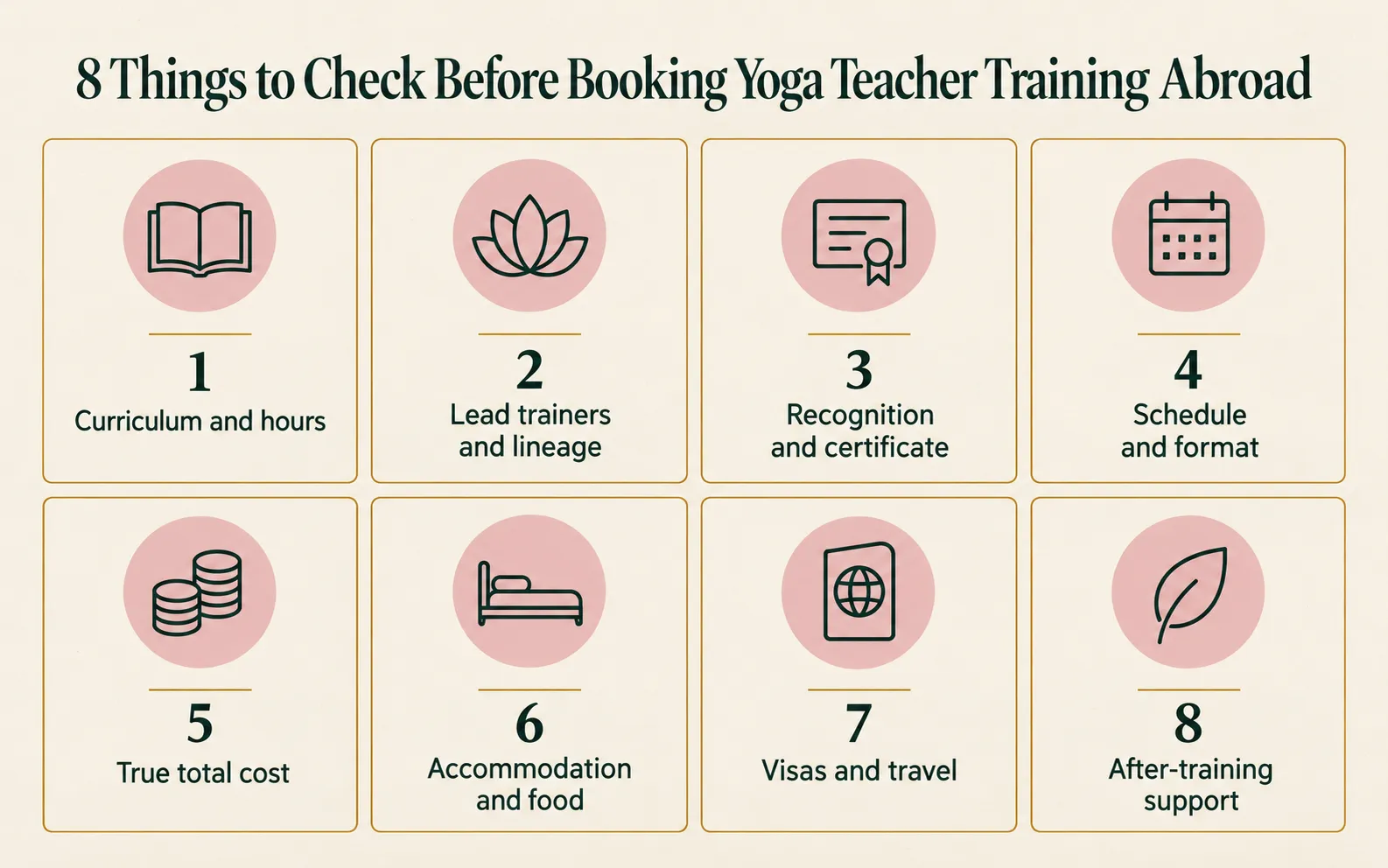
| Question group | Ask these questions | A good answer includes |
|---|---|---|
| Curriculum and hours | 1. What does each hour cover? 2. How much supervised practice and teaching assessment is included? | A course outline, hours by subject, practice teaching, feedback, and assessment details. |
| Lead trainers and lineage | 3. Who teaches most of the program? 4. What tradition or lineage shapes the teaching, how does it affect the course, and what is the maximum class size? | Trainer biographies, who teaches what, class size or ratio, and an approach that fits your values. |
| Recognition and certificate | 5. What certificate will I receive? 6. If a registry matters to me, what school listing and graduate requirements should I verify? | The exact certificate name, the assessment process, and a direct way to check any registry claim. |
| Schedule and format | 7. What does a normal training day look like? 8. Which parts are live or required in hybrid and online formats? | Daily times, attendance rules, practice expectations, technology needs, and assessment format. |
| True total cost | 9. What is the full tuition? 10. What is excluded, including deposits and refund terms? 11. Can I pay in instalments? | A written price, the exclusions, deadlines, the cancellation policy, and current payment options. |
| Accommodation and food | 12. Where will I stay? 13. What room, meal, and dietary details should I budget for? | The accommodation arrangement, what is charged separately, meal options, and extra local costs. |
| Visas and travel | 14. What entry documents or visa rules apply to my nationality? 15. How will I get from the airport to the training site? | A pointer to official immigration guidance, plus clear arrival instructions and transport options. |
| After-training support | 16. How is the final assessment handled? 17. What mentoring or refresher support follows? 18. Are there supervised teaching or community opportunities? | A named assessment process, continued contact, and realistic next steps for new teachers. |
What does Yoga Alliance recognition mean for an international training?
Yoga Alliance describes joining its registry as voluntary, and it is not government regulation. Its directory shows a school's stated designation, but a listing says nothing about teaching quality, assessment, cost or fit. Those still need your questions.
Read Yoga Alliance's credentialing options, then search the school's name in the Yoga Alliance school directory. Ask for the exact certificate name and the registration details you want to verify. Then ask studios, insurers or employers in your target market what they expect.
Is an intensive abroad better than local, hybrid, or online study?
An overseas immersion gives you concentrated time for study. Local, hybrid or online training fits more easily around work and family. Neither wins for everyone, so test each against your real schedule and teaching plans.
- Residential abroad: you give the training your full attention, and you plan for time away, travel, accommodation, meals and an intensive schedule. Ask about attendance, rest, modifications and missed sessions.
- Local weekend training: a slower pace lets you keep working and build relationships at home. Ask how often you meet, how practice teaching is supervised, and what happens if you miss a weekend.
- Hybrid or online/self-paced: flexibility helps when relocating is impossible. Ask which sessions are live, how you get feedback, what must happen in person, and how assessment works.
YAI offers in-person training in Jamaica, hybrid training, and online/self-paced formats. Ask which current pathway matches your goals before you pay.
What does yoga teacher training abroad really cost?
Tuition is the first line in your budget, and rarely the last. List every cost that could change your decision before you compare one school's headline price with another's.
- Tuition, deposit, payment deadlines and refund terms
- Accommodation, meals, dietary needs and local transport
- Flights, airport transfer, visa or entry costs, and travel insurance
- Practice clothes, supplies, phone or data costs, and a small emergency buffer
For YAI's 200-hour training, tuition is $3,000. Accommodation and meals are not included. Instalments are possible, so ask for the current plan rather than relying on an old schedule, and partial scholarships exist. Our Jamaica yoga teacher training cost guide breaks down the moving parts, and the Yoga Angels scholarship pathway explains the help available.
What travel questions should I answer before going to Jamaica?
Confirm your entry documents, arrival plan, insurance and emergency contacts before you book anything non-refundable. Keep the school's address and phone numbers saved offline, and ask exactly where to go when you land.
YAI Wellness Oasis is in Pondside, Yallahs, St. Thomas, about 40 minutes from Kingston. Norman Manley International Airport in Kingston is the nearest airport. For current entry rules, Jamaica's Passport, Immigration and Citizenship Agency lists the required travel documents: a valid travel document, a visa if applicable, and a completed Immigration/Customs C5 form. The Jamaica Customs Agency says arriving passengers must submit the electronic C5 declaration, which is free.
Check the official guidance for your passport and travel dates. Ask your insurer whether the policy covers your training activity, medical treatment or evacuation, trip interruption and cancellation. If you travel alone, agree the airport-to-site plan in advance.
A short packing list helps: travel documents, practice clothes, any required medication, a refillable bottle, a light layer, a charger, a notebook and key contacts. Confirm the school's own list before you fly.
Is yoga teacher training abroad right for me?
It suits you if you want focused study, can take the time away, and are ready to manage the full travel budget. It may not suit you if you need a fixed all-inclusive price, cannot leave home or work, or are mostly drawn by how the destination looks.
Be clear about why you are enrolling. If you want to teach, ask for supervised practice, feedback and the assessment standard. If you mainly want to deepen your own practice, ask how the program supports that. With an injury, a pregnancy or another health concern, ask about modifications and talk to an appropriate clinician before committing to an intensive schedule.
Think about the return home too. Ask studios in your target market what they look for, whether they require an audition or extra safety training, and which insurance they accept. A certificate alone does not tell you how your first teaching job will come about.
How does YAI answer the questions students should ask?
We can answer some of these directly. Dates, travel arrangements and other details that change should be confirmed for your nationality and preferred format.
Founder Sandra "Subhadra" Griffiths began her yoga journey in 1997 and established Yoga Angels teacher training in 2000. YAI has trained yoga teachers across Jamaica, the United States, Africa and the diaspora.
Our 200-hour teacher training is a 42-day residential program at YAI Wellness Oasis in Jamaica, and we also offer in-person, hybrid and online/self-paced formats. Tuition is $3,000. Accommodation and meals are not included, instalments are possible, and partial scholarships exist.
For support after training, ask every school about lifetime membership and refresher access, because they differ. Subhadra describes ours as "a school you never age out of." A 300-hour training also exists, and our 200- and 300-hour teacher training details show the next step.
Before enrolling, confirm the current dates, the required sessions for your format, accommodation and meals, airport transfer and any visa questions. If you are weighing levels rather than destinations, our 200-hour versus 300-hour guide may help.
Frequently asked questions
How do I choose a yoga teacher training?
Start with the teaching approach, trainers, curriculum, schedule, complete cost, travel requirements and support after assessment. Collect written answers from two or three schools, then choose the program that fits your life and your intended teaching market.
Is yoga teacher training abroad worth it?
It can be, when the immersion, format and community fit your goals. Add flights, accommodation, meals, insurance and time away to the budget before you decide an overseas program is cheaper or better.
Can I do yoga teacher training online?
Yes, if the school offers it. Ask how practice teaching, feedback, attendance, technology and final assessment work. YAI offers online/self-paced, hybrid and in-person formats, and you should confirm the pathway details before enrolling.
What are some important questions I should ask before yoga teacher training?
Ask who teaches, what the hours contain, how you will practice teaching, what the certificate means, what tuition excludes and what support follows assessment. Also ask about refunds, accommodation, meals, entry documents, the daily schedule and the arrival plan.
Is Yoga Alliance registration required to teach yoga?
Registration is voluntary, and it is not a government teaching license. Whether it matters depends on the studios, employers and students you want to work with, so verify the school's claim and check expectations in your target market.