
# Yoga for Seniors: A Gentle Guide for Adults 60+
You may be picturing a fast class where everyone touches their toes and drops to the floor. Yoga for seniors can look nothing like that. A good class uses a chair or a wall, moves slowly, leaves room for natural breathing, and builds in rest. You do not need to touch your toes, get onto the floor, or keep up with anyone to begin.
The short answer
Many older adults can try gentle yoga, including complete beginners, when the practice is adapted and taught with care. Yoga may support balance, flexibility, muscle strength, relaxation, and emotional wellbeing, as the NCCIH overview explains, but it is not a cure or a replacement for medical care. Start slowly, use support, and tell the instructor what you need.
What does a gentle yoga class for seniors look like?
A senior-friendly class puts control and comfort ahead of depth, speed, or perfect shapes. You might start seated with breathing and small movements, practise standing with a chair or wall nearby, and finish with quiet rest. Some classes stay in a chair the whole time. Others offer a seated version of each movement.
| Support option | What it can change | Question to ask before class |
|---|---|---|
| Chair | Lets you stay seated or hold on while standing | Can I use the chair for the whole class? |
| Wall | Gives you a steady point during standing work | Where should I stand for support? |
| No-floor option | Avoids kneeling and floor transitions | Can you show me a version that stays off the floor? |
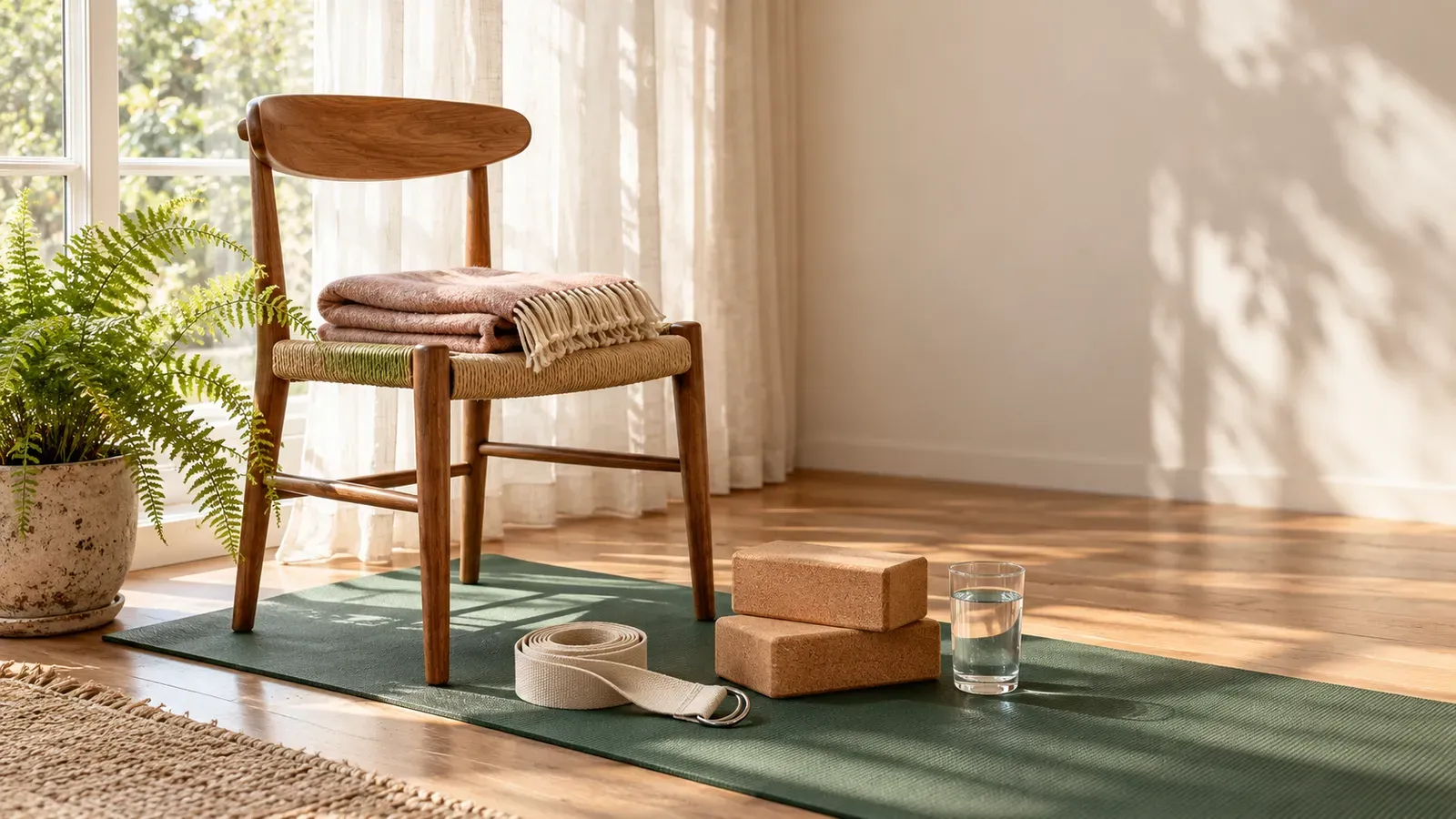
| Block, strap, or folded blanket | Brings the movement closer and reduces reaching | Which support makes this more comfortable? |
Notice your breathing, stay in a comfortable range, and rest whenever you need to.
Which yoga style is best for an older beginner?
The best starting point is a class whose pace and support match your body and confidence. Chair yoga keeps movements seated or chair-supported. Gentle Hatha gives you more time to learn basic postures. Restorative classes are slower and more supported.
Ask what happens in the first class instead of trusting the label. Will you need to kneel? Can you stay seated? Skip extreme poses, forceful breathing, and heat at the start. The National Center for Complementary and Integrative Health advises beginners to avoid headstands, shoulder stands, lotus position, and forceful breathing, and notes that hot yoga has overheating and dehydration risks.
What beginner movements can be adapted for seniors?
A teacher can adapt familiar movements so you stay seated, use a wall, or take a smaller range of motion. Treat these as examples to talk through with an instructor.
- In seated mountain, you sit with both feet supported, lengthen your spine without stiffening, relax your shoulders, and breathe easily.
- Seated cat-cow has you move between a tall chest and a slightly rounded back, hands on your thighs. Skip it if your clinician has told you to avoid spinal flexion.
- For supported standing balance, stand beside a sturdy chair or wall with one hand close, and shift your weight between your feet before trying single-leg balance.
- In chair warrior, you stand beside a chair, take a comfortable step, and bend only as far as you can control. Do not pull yourself deeper.
The instructor should show you a seated or neutral-spine alternative. If a movement brings sharp pain, dizziness, chest pain, unusual shortness of breath, or fear of falling, stop and tell the teacher.
What benefits may yoga offer older adults?
Research suggests yoga may help with balance, flexibility, muscle strength, and mood, though results are never promised for every person or class.
A 2023 systematic review of 15 studies of adults age 60 and older found possible improvements in balance, flexibility, muscle strength, and depressive symptoms after sensitivity analysis. The authors reported variation between studies, so "may help" is the honest wording. Read the review on PubMed.
The National Institute on Aging's exercise guidance lists yoga among activities that can combine types of exercise. It recommends moving slowly, using a sturdy chair, person, or wall when needed, breathing normally, and never stretching until it hurts.
Think of yoga as one activity alongside medical care and any other movement your healthcare professional recommends. A practice you can repeat comfortably does more for you than a long session you push through.
Is yoga safe for seniors?
Gentle yoga is often suitable when adapted to the person, but "gentle" does not make every pose safe for every body. Injuries, health conditions, and balance problems all call for extra caution.
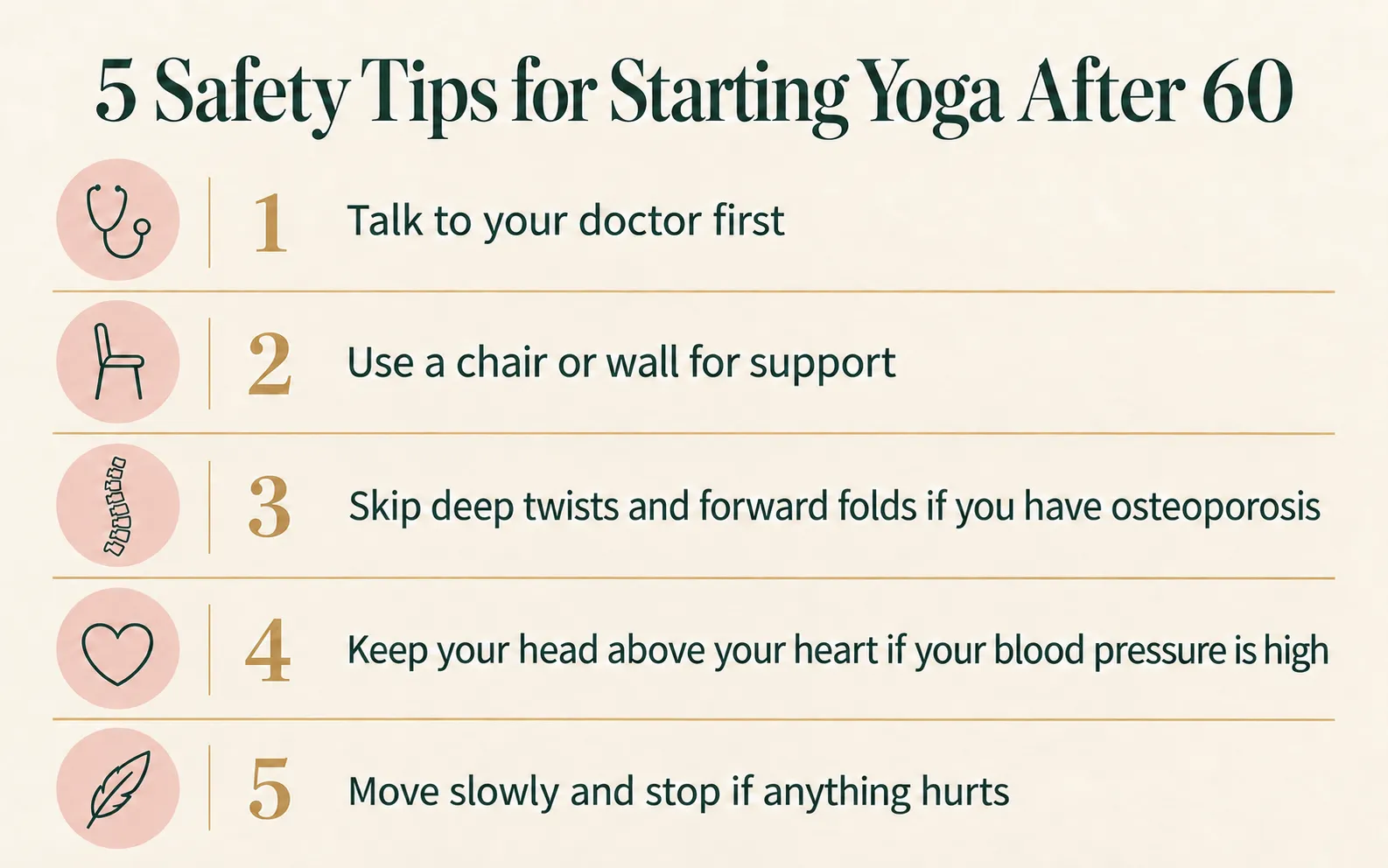
Before your first class, speak with a healthcare professional if you have osteoporosis, a spinal fracture, high blood pressure, glaucoma, a recent operation, a hip or knee problem, a joint replacement, or a significant balance concern. Then share their advice with the instructor. NCCIH notes that older adults and people with health conditions may need to modify some poses and practices.
Five safety rules for a first class
- Use support early. Keep a sturdy chair or wall close during standing and balance work. Support is a sensible tool, and nobody needs to apologize for it.
- Keep breathing normally. Do not hold your breath or force a breathing exercise, and pause if you feel unwell between positions.
- Protect your spine if you have osteoporosis. With osteoporosis or a high risk of spinal fracture, ask for alternatives to deep forward bending and forceful or end-range twisting. The Bone Health and Osteoporosis Foundation's safe-movement guidance recommends professional guidance and describes these precautions.
- Ask about head-below-heart positions. With high blood pressure or heart disease, check with your clinician and teacher about which inversions or deep bends suit you. Harvard Health advises caution with inversions.
- Stop whenever you like. You can rest, skip a movement, or stay with the chair version. An attentive, qualified teacher will welcome that choice.
How can seniors avoid stressful floor transitions?
Choose a class that stays seated and standing, and floor transitions never become part of your first visit. When you book, ask: "Can I take the class without kneeling or lying on the floor?"
If a class does include floor work, ask the teacher to walk you through the transition first. Use only a sturdy support that will not slide, and if you feel unsteady, stay with the no-floor option.
What should a beginner bring to a first yoga class?
Bring comfortable clothing, any water you normally carry, and the health information your instructor has asked for. If you will be standing, wear stable footwear when the teacher permits it. NIA recommends comfortable, stable footwear or going barefoot for grip, so ask what suits the floor.
Arrive early enough to mention balance concerns, surgery, joint replacements, pain, or movements you have been told to avoid. Then ask:
- Can I stay seated whenever I need to?
- What should I do if I feel dizzy or uncomfortable?
- Are there no-floor options for every movement?
- Can I rest or leave early without disrupting the class?
You do not need to be flexible, fit, or experienced, and you do not need to do every movement. The right class lets you learn at a pace you can keep up safely.
How does YAI's Golden Age Yoga support older adults?
At Yoga Angels International, Golden Age Yoga is for adults 60+ and focuses on mobility, breathwork, and graceful aging. It is rooted in patience, compassion, and mindful care.
To see the current option, visit Golden Age Yoga for adults 60+ and use the weekly class calendar to choose Golden Age Yoga. If you are also planning travel, read how to choose a yoga retreat in Jamaica or compare a one-day yoga retreat in Jamaica. Check with a healthcare professional about your own needs first.
Frequently asked questions
Is yoga safe for seniors who have never tried it?
Often, yes, if the class is genuinely gentle and offers chair, wall, and rest options. Explain your needs before class and skip any movement that causes pain, dizziness, or fear.
Is chair yoga good for older adults with limited mobility?
Chair yoga lets you work on breathing, mobility, and controlled movement without floor transitions. Use a stable chair, move slowly, and ask about adaptations for your condition.
What yoga poses should seniors avoid?
No single list fits every senior. With osteoporosis or spinal fracture risk, you may need alternatives to forward bending and forceful twisting. With high blood pressure or heart disease, inversions may need modifying. Ask a teacher for an alternative instead of copying a pose from a video.
Can I do yoga if I have joint pain or a joint replacement?
You may be able to practise with a smaller range of motion, chair support, or more rest, but the right adaptation depends on the joint and your recovery. Tell both the instructor and your healthcare professional which movement is uncomfortable.
What is the best yoga for seniors who are beginners?
Look for a class described as gentle, chair, senior, or beginner-friendly, and ask how it handles standing, balance, breathing, and floor work. Choose one that respects your pace and lets you stop without pressure.