
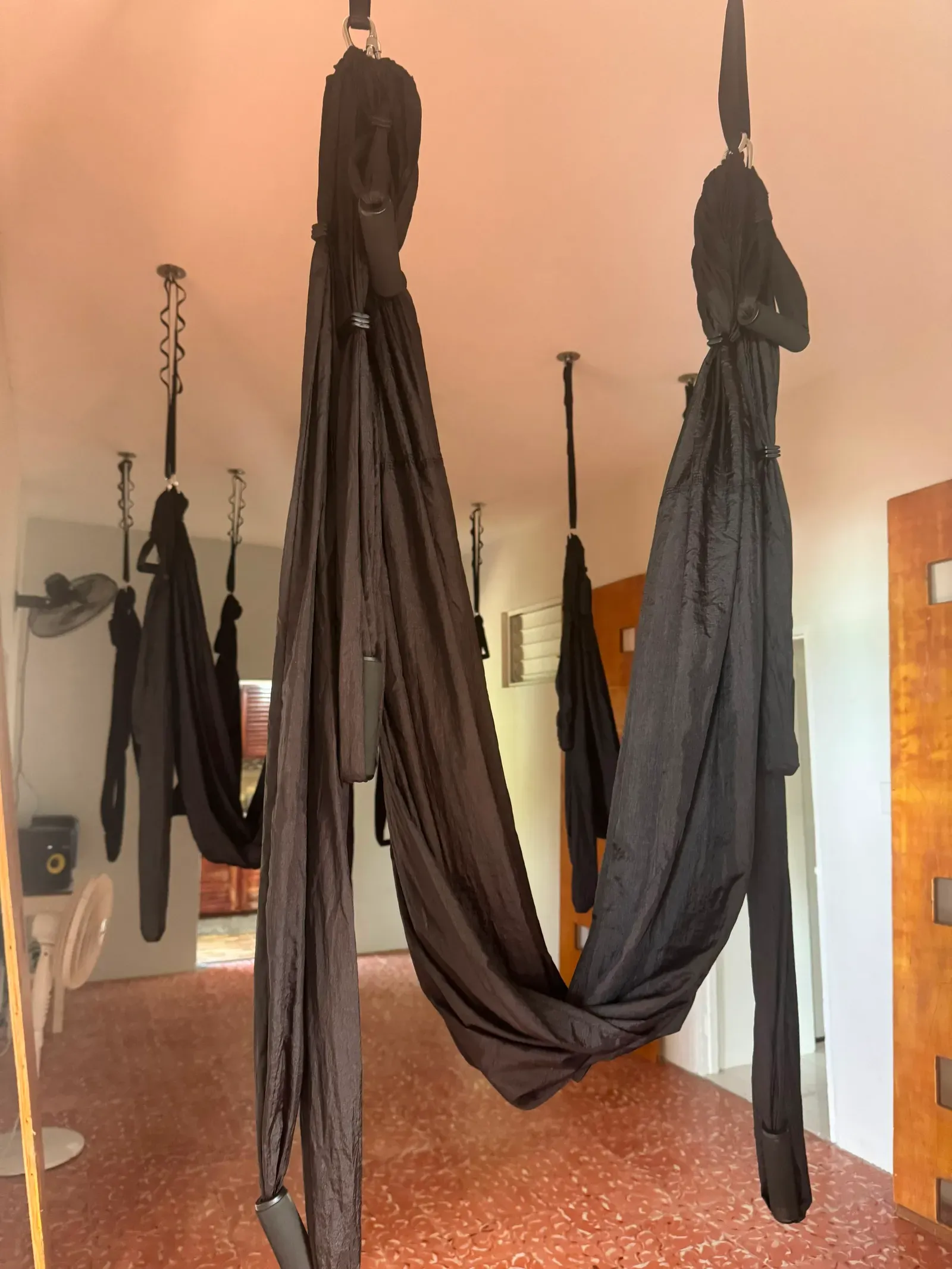
You have seen the photos of people resting in a fabric hammock, and you are wondering two things: will I fall out, and will I look silly? A first aerial yoga class is gentler than it looks. The hammock holds part of your weight, so you can think about your breath and how a stretch feels instead of how hard you are working.
We teach Aerial Hammocks Movement Therapy at the YAI Wellness Oasis in Pondside, Yallahs, St. Thomas, Jamaica. Here is our beginner guidance.
Can a beginner start aerial yoga?
Yes. Aerial yoga for beginners uses a fabric hammock to carry part of your weight while you practice simple yoga shapes, stretches and rest. You do not need prior yoga, unusual strength or deep flexibility (Healthline). Wear fitted clothes with sleeves, take off your jewelry, and ask a clinician first if pregnancy or a health condition affects inversions.
What does the aerial yoga hammock actually do?
It gives your body one more place to rest. The hammock can hold your hips, back, hands or legs while other parts stay on the floor, which changes the balance and the way a stretch feels (Healthline). You can sit, kneel or lie in it, adjust a little as it sways, and settle into the open fabric while you breathe.
Aerial silks are a different thing. Aerial yoga uses a sling or hammock to assist yoga postures, stretching and relaxation. Silks usually means circus-style work on long fabric, with another goal and its own vocabulary. Ask any studio what its beginner session includes before you book (Healthline).
Is aerial yoga hard for beginners?
It can feel strange at first, but beginners start with simple, supported work. A first session may go something like this:
- Start on the floor. Breathe, warm up and learn how to approach the hammock.
- Meet the fabric. Hold it, lean into it and sit in it. It may sway until you get used to it.
- Try supported shapes. Some of your weight stays in the hammock and some stays on the floor.
- Choose whether to invert. A gentle inversion may be offered, and "not today" is a complete answer.
- Come back slowly. Sit for a moment and tell your teacher if you feel light-headed or nauseated (USC Leiden).
Expect some pressure where the fabric gathers under or around your body. A firm sensation is worth mentioning early. If the placement feels sharp, numb or painful, come out and ask the teacher to adjust it. Do not stay quiet to avoid holding up the class.
Keep your hands relaxed. You do not need to pull yourself up or grip the fabric like a climbing rope, so ask for a cue if your forearms start working harder than the pose needs.
Do you need to be strong or flexible for aerial yoga?
No. A beginner class adapts to the range of movement and confidence you bring that day. The hammock may make some shapes easier to reach, and you still listen to your body.
| Beginner worry | A more useful way to think about it |
|---|---|
| "I need upper-body strength." | You are learning to use support, and nobody asks you to climb to the ceiling. |
| "I need to be flexible." | Move only as far as you can breathe comfortably. |
| "I have to go upside down." | Inversions are optional. Staying upright is still a real session. |
| "I might damage the hammock." | Remove jewelry and follow the studio's equipment instructions. Ask about the setup if you are unsure. |
| "Aerial yoga is only for very fit people." | A beginner class is the place to talk about adaptations. You do not have to earn it by getting flexible first. |
If you are worried about body size or equipment, ask the studio what support and weight limits apply to its specific hammocks. Internet numbers cannot tell you whether a particular setup suits you.
What should you wear to your first aerial yoga class?
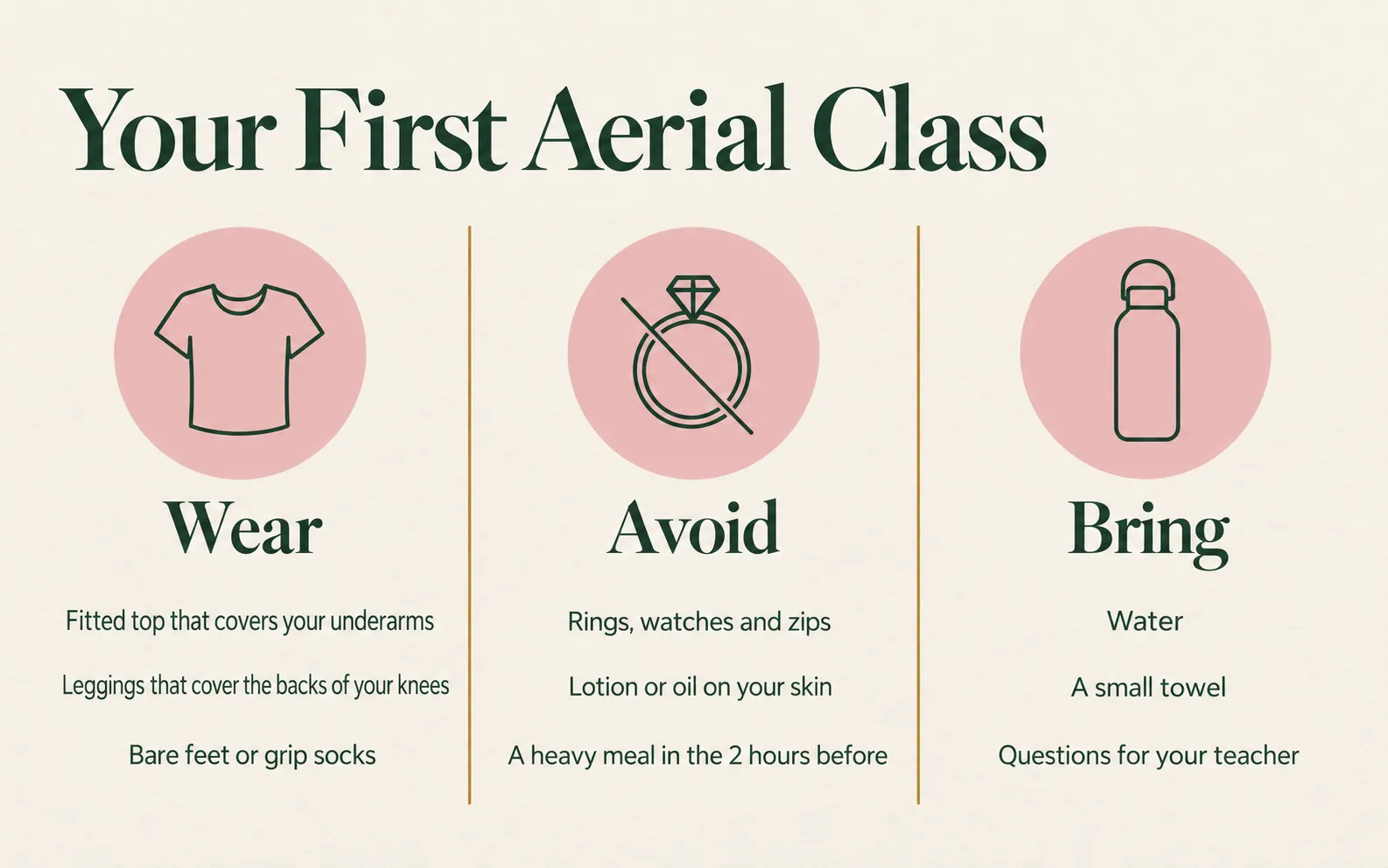
Wear close-fitting clothes with sleeves, plus long pants or leggings. Covering the skin that touches the fabric helps reduce rubbing, and zippers and jewelry can damage a hammock (USC Leiden).
A fitted T-shirt or long-sleeved top and leggings or long pants work well, and so do bare feet unless your studio says otherwise. Leave off rings, bracelets, earrings, necklaces and watches, along with anything with zippers, buttons or Velcro that can catch the fabric. Skip body lotion or oil right before class, since slippery skin makes it harder to settle into the hammock. Eat as you normally would, but do not arrive stuffed or dehydrated.
Bring water in a closed bottle, a hair tie if you need one, and a note of any injuries, health conditions or dizziness to tell your teacher about.
Who should skip aerial yoga or ask a doctor first?
Ask a clinician before an aerial class if you are pregnant, or have glaucoma or another eye condition, high or low blood pressure, a heart condition, recent surgery, an injury that is still healing, vertigo, or significant balance or motion-sickness problems. The National Center for Complementary and Integrative Health says pregnancy, injuries, balance issues, severe high blood pressure and glaucoma may require yoga modifications (NCCIH).
Inversions deserve extra care if you have glaucoma. A small 2015 study found that four head-down yoga positions raised eye pressure within one minute in people with and without glaucoma, and the pressure moved back toward baseline after they sat up (PLOS ONE via NIH). That does not make every aerial class unsafe. It is a good reason to get individual advice before going upside down.
Tell your teacher about your health before the session begins. A teacher can keep you upright or suggest a gentler starting point, but cannot replace medical clearance. If you feel dizzy, numb, unusually breathless or unwell, come out of the shape and stop.
What are the benefits of aerial yoga for beginners?
Many people enjoy the support and the movement, and research on aerial yoga is still limited. For someone who wants to explore movement with help, it may feel friendlier than a pose on a mat.
An American Council on Exercise study followed 16 healthy, physically active women through three 50-minute aerial yoga sessions per week for six weeks. The researchers described a single session as low-to-moderate intensity and reported changes in selected health measures. It was a small study of one group, so it cannot promise treatment, weight loss or the same result for every beginner (ACE-sponsored research).
For a first class, a simple measure works well: could you breathe, speak up, and leave knowing what your body needs next?
How does aerial hammock yoga work at the YAI Wellness Oasis?
At the YAI Wellness Oasis, Aerial Hammocks Movement Therapy is part of the Yoga Experience on One Day For You, alongside Rope Wall and yoga. Groups of 1 to 50 are split into rotations, with up to 6 guests per Aerial session. Rope Wall also takes up to 6 guests.
One Day For You is $99 per person, and a $25 deposit holds your spot. It includes a welcome drink, Pond-Side Adventure, a beach-side walk, Bar Mouth Beach, the Yoga Experience, a meal and drink, an Ocean View Villa tour, INNERISM and a bonfire. You choose your arrival time.
To see the setting, read our Jamaica wellness page. To compare a supported practice, try Rope Wall yoga. The full itinerary is on our one-day yoga retreat in Jamaica page. If you are thinking about teacher training, aerial hammock work is not part of our 200-hour yoga teacher training.
If you spend time at the beach, please read our ocean safety notice. The sea may be deep and conditions can change without warning. Non-swimmers should not enter, and no one should swim alone. Do not swim in rough seas, strong currents or bad weather. Children must be supervised by an adult at all times.
Frequently asked questions
Can a complete beginner do aerial yoga?
Yes. Tell the teacher it is your first time and let the hammock carry part of your weight. Prior yoga experience is not required, but your teacher should know about any health concern that affects balance or inversion.
What should I wear to my first aerial yoga class?
Fitted clothing with sleeves, and long pants or leggings. Remove jewelry, avoid zippers or Velcro, and check whether the studio wants bare feet or a particular type of sock.
Will aerial yoga make me dizzy or nauseous?
It can, especially while you get used to swinging or when you come upright after an inversion. Move slowly, sit when you come down and tell your teacher if the feeling continues.
Who should not do aerial yoga?
No internet checklist can clear you for an aerial class. If you are pregnant or have glaucoma, blood-pressure or heart concerns, recent surgery, a healing injury, vertigo or balance problems, ask a clinician first and tell the teacher what they advise.
Can you fall out of an aerial yoga hammock?
Any suspended practice needs careful instruction. In your first class, follow the teacher's cues and do not try an inversion alone. Do not copy a home setup from a video until you have learned how the equipment and rigging are checked.
Is aerial yoga right for you yet?
If you are still nervous, book a free call and tell us what worries you. We can talk through whether Aerial Hammocks Movement Therapy is a sensible first step for you or whether Rope Wall is a better place to begin.