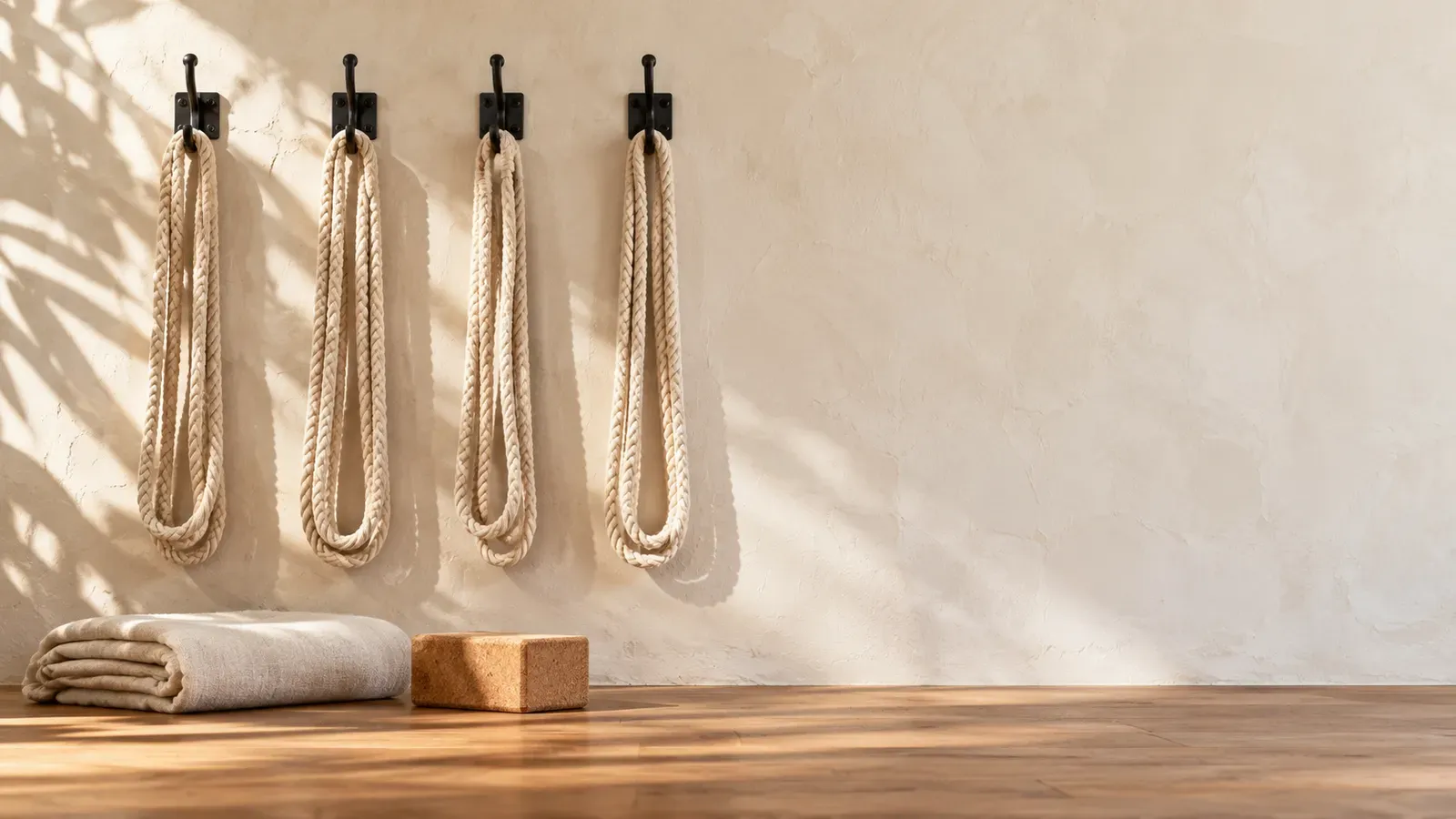
You see ropes hanging in loops from a studio wall and wonder what you are supposed to do with them.
Rope wall yoga uses ropes fixed to a wall to support your body in standing poses, stretches, backbends and some inversions. It comes from the Iyengar tradition and is not aerial yoga. The wall gives you something steady to hold or lean into. Whether a given pose suits you still depends on your body.
At YAI Wellness Oasis in St. Thomas, Jamaica, we call our version Rope Wall Therapy. Here is what the ropes do, what a session may include, and when to check with a doctor first.
What is rope wall yoga?
Rope wall yoga is a supported practice that uses wall-mounted ropes as props. It grew out of the Iyengar tradition, where B.K.S. Iyengar used ropes and anchors to help students work with alignment. Yoga Journal describes that history and the way rope work can help students feel alignment more clearly.
You may also meet the term Yoga Kurunta, which appears in Iyengar Yoga UK material about rope practice. It does not promise one sequence or one type of equipment, so ask a studio that uses it what the class includes.
Instead of balancing every part of your body by effort alone, you use the ropes as a steady reference while you notice your breath, direction and alignment.
How do the ropes support your body?
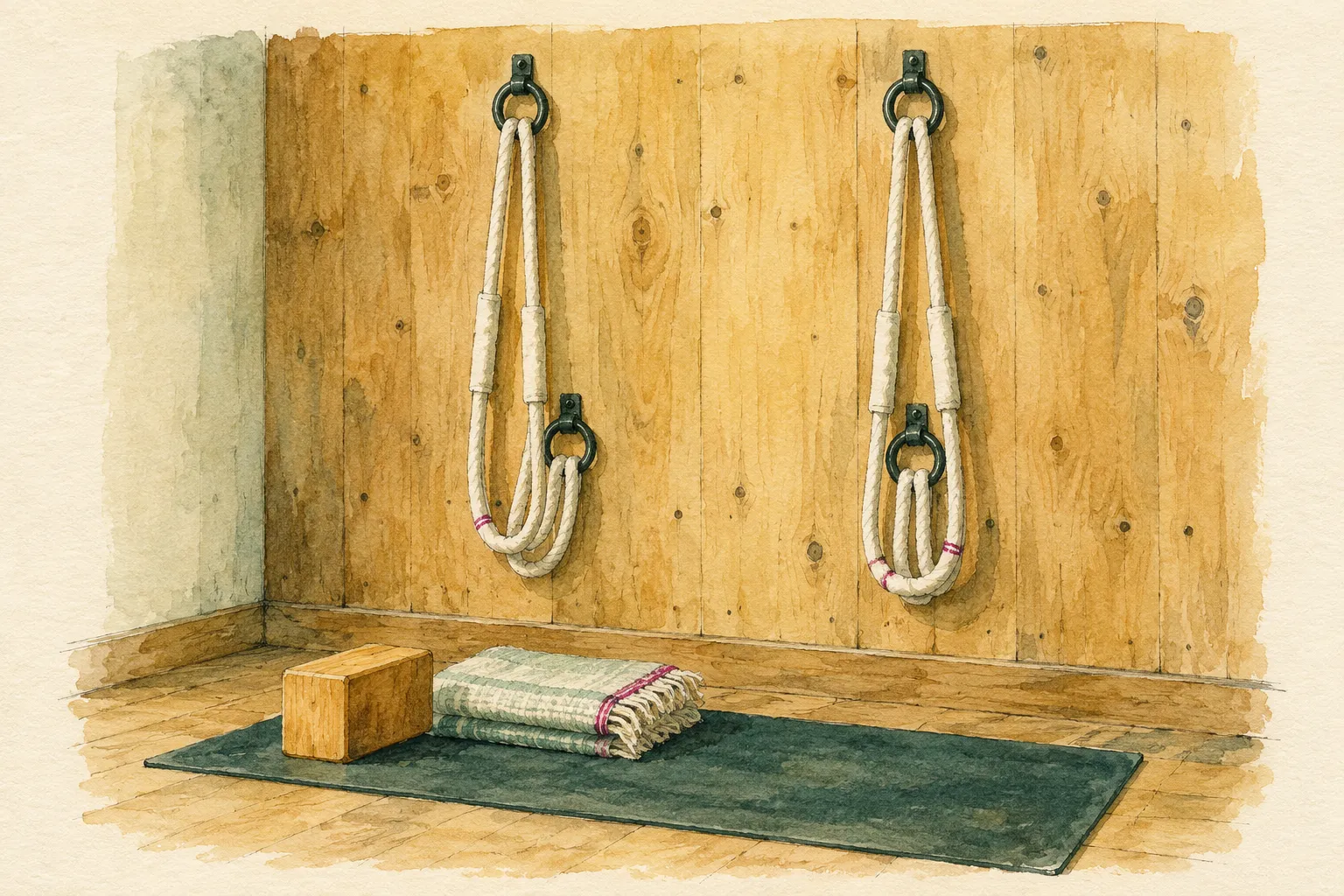
The ropes give a part of your body a fixed point to hold, lean against or rest into. Depending on the pose and the setup, you might hold a rope with your hands, place a leg in a loop, or let a loop support your pelvis or thighs.
Think of the rope as a steady partner. A teacher helps you decide how much weight to give it. The wall also gives feedback, because you can feel when you are drifting, gripping or losing your line.
That is why it feels different from a mat class. Support makes a position more accessible, but it stays a real position with real risk, so a teacher should set it up, show you where the rope belongs and help you out of it slowly.
What poses can you do on a yoga rope wall?
These are examples of what you may see in a class, not instructions for practicing without a teacher.
- In a standing lean, you hold a rope with your feet on the floor and lean away from the wall. The rope gives your arms and spine a steady line.
- In a supported downward dog, a loop holds the upper thighs while your hands stay on the floor. You may find more length through the back.
- In supported standing poses such as triangle or a lunge, the rope gives you a point of contact, so you can attend to the shape instead of wobbling.
- In a supported chest opener or backbend, the wall and ropes let a teacher offer an opening through the front of the body, introduced gradually and without forcing the spine.
- In a supported hanging inversion, a loop holds the pelvis while your head moves below your heart. It is the biggest change of perspective and the position that deserves the clearest screening and instruction.
What are the benefits of a yoga wall?
The practical benefits are support, feedback and choice. Many people find that ropes help them stay in a position long enough to notice alignment, explore a stretch with less muscular effort, or try a supported version of a pose they would not attempt unaided. Yoga Journal also describes rope work as helping students carry a felt sense of alignment back to their floor practice.
A rope wall does not diagnose or treat an injury. If you hope for relief from back pain, do not assume an inverted or traction-like position is right for you. NCCIH says the evidence for yoga and low-back pain suggests only a slight benefit, and it advises speaking with a health care provider about a medical problem rather than using yoga to delay care.
Tell the teacher where you feel pain and what aggravates it. The right choice may be an upright position, a smaller range of motion, or no rope work that day.
Is rope wall yoga the same as aerial yoga?
No. Rope wall yoga uses ropes fixed to a wall, so you always have a stable point of contact. Aerial yoga uses a fabric hammock hung from above, which moves with you. Both can feel freeing.
At the Oasis we offer both Rope Wall Therapy and Aerial Hammocks Movement Therapy. To understand the hammock first, read our guide to aerial hammock yoga for beginners.
Who should be careful with rope wall yoga?
Talk to a doctor and the teacher before class if you are pregnant, have a health condition, are recovering from an injury, or feel unsure about inversions. NCCIH specifically lists severe high blood pressure, balance issues, glaucoma, lumbar spine disease and other injuries among conditions that may require yoga modifications. The table below is a starting point for that conversation, not a diagnosis.
| If this applies to you | Before you try the rope wall |
|---|---|
| High blood pressure | Ask your doctor about inversions and tell the teacher; begin with upright options if cleared. |
| Glaucoma or another eye condition | Ask your eye-care provider before any head-below-heart position. |
| Pregnancy | Check with your health care provider and ask for pregnancy-appropriate modifications. |
| Recent injury | Get guidance before loading the affected area, and tell the teacher exactly what happened. |
| Neck, back or joint problem | Ask about safe ranges and supported alternatives before class. |
| Age 60 or older | Discuss your needs with your provider and teacher, then start gently. Our gentle yoga for seniors guide may help you compare options. |
You can decline any position. A well-run session offers an upright alternative and never pressures you to invert because other students are doing it.
What is rope wall yoga like at YAI Wellness Oasis?
Our Rope Wall Therapy is described as "deep spinal release supported by the wall." The Oasis is oceanfront in Pondside, Yallahs, St. Thomas, Jamaica, about 40 minutes from Kingston.
Sandra "Subhadra" Griffiths, YAI's founder, describes the experience this way:
"Pose to pose. Breath to breath. Suspended between the mountain and the sea."
>
"Just you, the rope, your breath...and the freedom to LET GO."
She also calls it an invitation "to stretch deeper, turn your perspective upside down." Those are her words for how it feels. Inversions stay optional for every guest.
The rope wall is part of the Yoga Experience in One Day For You, alongside Aerial Hammocks and yoga. The day suits groups of 1 to 50, with up to 6 guests in a Rope Wall session. The price is $99 per person, and a $25 deposit holds your spot. If you want a longer stay, see our Jamaica wellness retreats page.
Is rope wall yoga good for beginners?
It can be, if you start with upright positions and a teacher guides the setup. You do not need advanced poses to begin. You do need to speak up, move slowly and skip anything that feels wrong.
Before your first session, ask which positions suit a beginner, which involve an inversion, and how you will be supported getting in and out. That short conversation helps more than comparing yourself with regulars.
Frequently asked questions
What is rope wall yoga?
It is yoga practiced with ropes anchored to a wall. The ropes act as props, giving you support and feedback in selected standing poses, stretches, backbends and inversions. Its modern use is tied to the Iyengar tradition.
Is rope wall yoga good for back pain?
It is not a cure for back pain, and a rope wall does not replace medical care. Yoga research in general suggests a slight benefit for low-back pain, so ask a doctor or physical therapist whether this practice fits your situation before you try it.
Is rope yoga good for beginners?
Many beginners can start with upright, supported positions when a teacher is present and knows their health history. Leave inversions for later, or skip them.
What is the difference between aerial yoga and wall yoga?
Wall yoga uses ropes attached to a wall. Aerial yoga uses a suspended fabric hammock. The wall is more stable, while the hammock moves and supports you from above.
Is rope wall yoga safe with high blood pressure?
A general article cannot answer that. Ask your doctor about the positions you want to try, tell the teacher about your blood pressure, and start with upright options only if you are cleared to practice.
If you want to ask about the setup before booking, book a free discovery call with YAI. If a day at the Oasis feels right, book One Day For You.